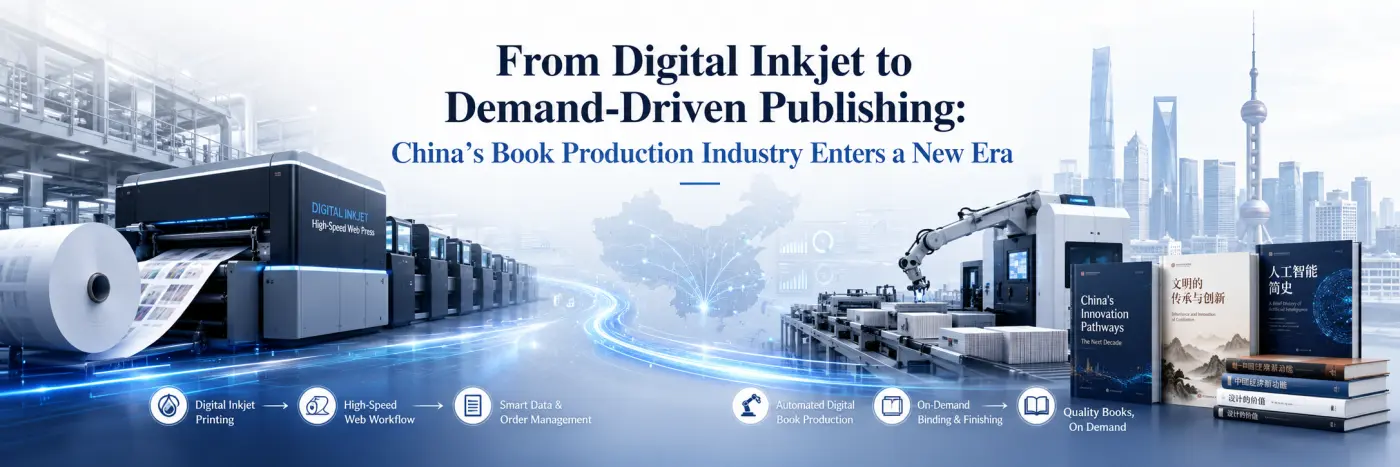
China's printing industry is undergoing more than a technological upgrade. It is experiencing a fundamental change in how printed products—especially books—are ordered, produced, bound, stored and delivered.
According to industry reports, digital printing had crossed a symbolic 50% threshold in parts of the Chinese printing market by 2025, while conventional offset business declined by approximately 12% over the same period. Although the exact percentage varies depending on whether market share is measured by production value, print volume, number of jobs or specific application segments, the direction of change is unmistakable: digital production is moving rapidly from a supplementary process to a central part of China's printing infrastructure.
This transition is being accelerated by the simultaneous maturation of two technologies: domestically manufactured high-speed digital inkjet web presses and automated digital finishing systems represented by HDP.
Together, they are turning print-on-demand from a limited short-run service into an industrial publishing model.
The Market Is Moving from Long Runs to Fragmented Demand
Offset printing remains highly efficient when thousands or tens of thousands of identical copies are required. Once the plates are prepared and the press is running at stable speed, its unit production cost is difficult to match.
The problem is that an increasing proportion of today's orders no longer follow that pattern.
Publishers, commercial printers and online print platforms are receiving more orders involving:
Smaller quantities
More titles and SKUs
Frequent content revisions
Regional or customer-specific editions
Shorter delivery times
Uncertain initial demand
Repeated replenishment in small batches
Under these conditions, the traditional economic logic of offset printing becomes less effective. Plate making, makeready, paper waste and production preparation must be absorbed by fewer copies. The apparent unit cost advantage may also be offset by inventory storage, capital tied up in unsold books, repeated handling and eventual discounting or disposal.
Digital inkjet printing changes the calculation. There are no printing plates, jobs can be changed directly from digital files, and different titles can be produced consecutively. This allows printers and publishers to base production quantities more closely on actual orders rather than long-term forecasts.
Globally, the same structural movement is already visible. Smithers estimated that digital print sales would reach approximately US$175.2 billion in 2025, while offset lithography continues to face declining demand in several major applications.
Domestic Inkjet Technology Has Reached Industrial Scale
China's transition has accelerated because domestic digital inkjet equipment is no longer positioned simply as a lower-cost alternative.
Chinese manufacturers have made substantial progress in printhead control, ink management, colour stability, variable-data processing, web transport and production reliability. High-speed inkjet presses are increasingly capable of handling extended industrial production rather than only occasional short-run work.
China had already installed more than 800 high-speed inkjet presses by the end of 2021, compared with only 41 in 2015, with domestic manufacturers supplying a significant proportion of the installed base.
More recent assessments from China's publishing and printing authorities confirm that domestically developed industrial inkjet presses and digital finishing equipment are becoming increasingly mature. Chinese suppliers have expanded their capabilities from uncoated book papers to a wider range of substrates while improving coating, droplet control, ink-volume management, inspection and production automation.
This development has lowered the investment threshold for digital production and made high-speed inkjet accessible to a broader range of Chinese printing companies.
However, printing faster is only part of the solution.
Digital Finishing Was the Missing Link
A digital press can change from one title to another almost instantly. Conventional finishing equipment generally cannot.
Traditional folding, collating, sewing, binding and trimming systems were designed around repeated production of the same format. When every book block has the same page count, thickness and trim size, the workflow is highly efficient. When titles and specifications change continuously, manual separation, sorting, adjustment and job tracking can quickly become production bottlenecks.
This creates a fundamental mismatch: the press may be digitally variable, while the finishing department remains mechanically fixed.
An effective digital book production line must therefore be capable of managing:
Frequent title changes
Variable page counts
Different book block thicknesses
Correct page and signature sequences
Automatic job separation
Short and medium production runs
Barcode- or data-driven changeovers
Integration with downstream binding and trimming
The growing maturity of HDP digital finishing solutions is helping close this gap.
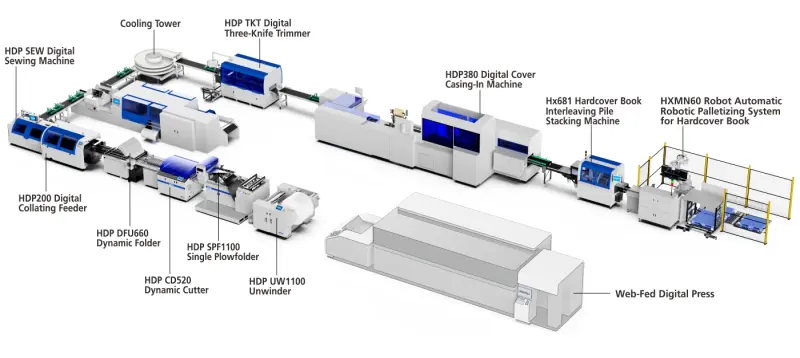
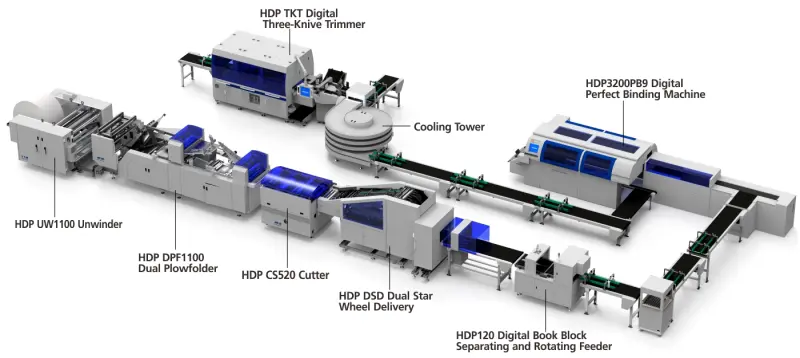
HDP systems are designed to connect directly with roll-fed or sheet-fed digital presses and convert digitally printed output into organised, bindable products. Depending on the application, the workflow can include unwinding, slitting, longitudinal folding, dynamic cutting, variable folding, collating, sewing, saddle stitching, perfect binding, hardcover binding and intelligent three-side trimming.
This means the digital workflow no longer ends when the printed web leaves the press. It can continue through finishing as a coordinated, data-driven production process.
From a Printed Roll to a Finished Book
The strategic importance of digital finishing can be seen clearly in wide-format book production.
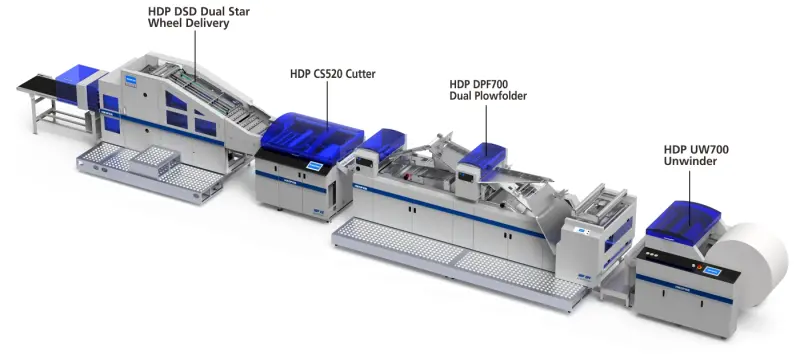
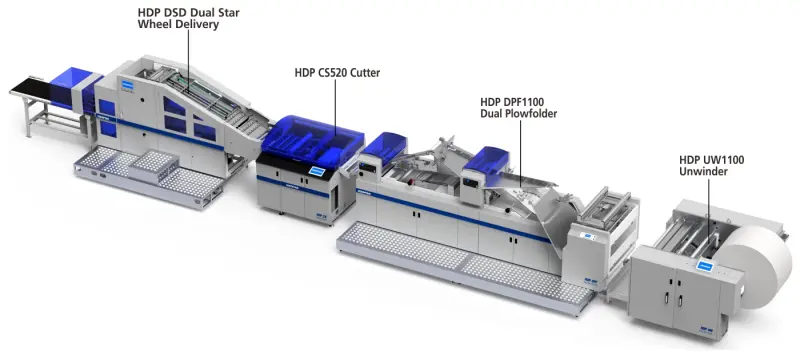
The HDP1100 Wide-Format Roll-to-Book-Block Digital Line, for example, is designed for digital webs up to 1,100 mm wide and production speeds of up to 200 metres per minute. It integrates unwinding, longitudinal plow folding, four-, six- or eight-page signature production, cross-cutting, side gluing, separation, stacking and delivery.
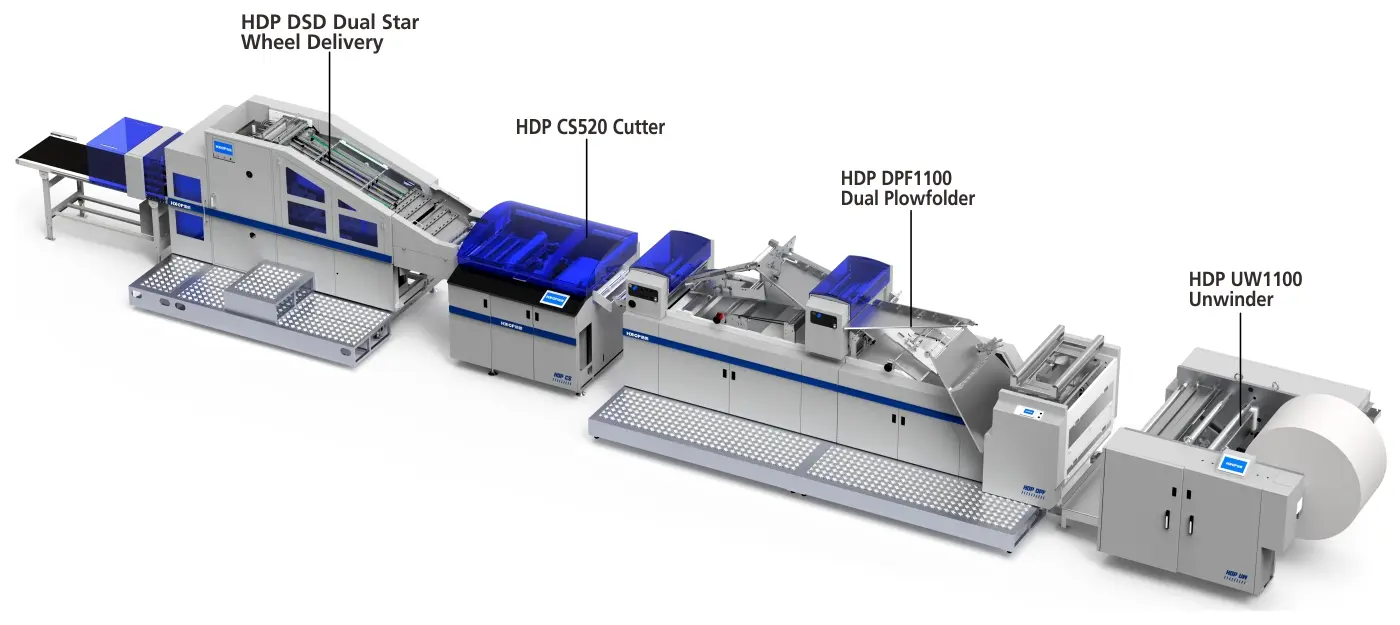 HDP1100 Wide-Format Roll-to-Book-Block Digital Line
Its purpose is not merely to process paper quickly. It is to transform a continuously printed digital web into correctly organised book blocks that are ready for downstream binding.
That capability is essential for industrial print-on-demand. Producing one printed copy has been technically possible for many years. Producing one correctly sequenced and bindable book block efficiently—while the next book may have a different title, page count or thickness—is a much more demanding challenge.
HDP's digital finishing systems provide the physical connection between variable printing and variable books.
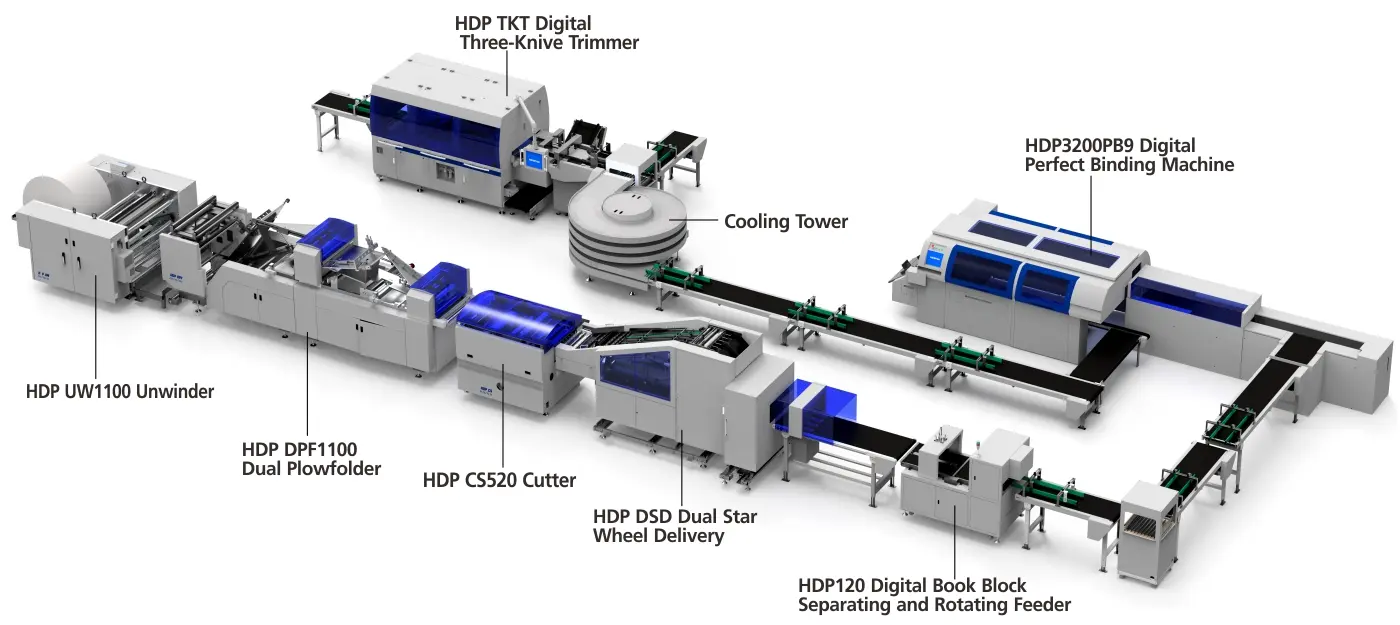 HDP1100 Roll-to-Dynamic-Folding-to-Perfect-Binding Digital Line
Print-on-Demand Is Becoming Demand-Driven Publishing
The result is a broader change in the publishing business model.
Traditional publishing production normally begins with a forecast:
Demand forecast → Large print run → Binding → Warehousing → Sales → Replenishment
Demand-driven publishing begins with market information:
Order or inventory signal → Digital printing → Automated finishing → Binding → Storage or direct dispatch
This does not mean that every book must be produced as a book of one. Nor does it mean that offset printing or book inventory will disappear.
Instead, publishers can classify titles according to their demand characteristics:
High-volume, predictable titles remain suitable for offset production.
Medium-volume titles can be replenished in smaller and more frequent batches.
Low-volume and backlist titles can be produced against accumulated or individual orders.
New titles can begin with conservative quantities until market demand becomes clearer.
Regional, educational or personalised editions can be produced from digital files when required.
The objective is not necessarily zero inventory. It is better inventory.
Connecting Production with Warehousing and Fulfilment
The transformation becomes even more powerful when digital printing and finishing are connected with logistics data.
In May 2026, Hongxianda Digital Printing, part of HXD Group, signed a strategic cooperation agreement with HXCP to introduce an HDP1100 production line. HXD's core capabilities include book warehousing, transportation, order fulfilment and distribution. By adding digital book production, the group is moving upstream into print-on-demand publishing and creating a more integrated service model for publishers.
The proposed workflow connects digital printing, automated book block production, binding, warehousing and delivery. Books can be produced in smaller quantities, replenished according to actual demand and, when appropriate, dispatched without entering long-term storage.
This illustrates an important trend in China: new digital book factories are not necessarily being built only by traditional printing companies.
Logistics operators, publishing service companies, e-commerce platforms and supply-chain organisations may also move into book manufacturing because they already possess valuable customer relationships, inventory information, fulfilment infrastructure and demand data.
The competitive advantage will not come from owning a digital press alone. It will come from connecting production capacity with real market demand.
China Is Building the Infrastructure for POD
China's policy direction is reinforcing this transition.
The national Printing Industry Digitalisation Three-Year Action Plan for 2025–2027 calls for advances in high-precision inkjet control systems, next-generation prepress workflows and high-speed variable-data processing. It also specifically encourages the development of print-on-demand publishing, mass customisation and coordinated supply-chain optimisation.
This is significant because successful POD requires more than isolated machines. It requires interoperable data, automated production equipment, quality inspection, workflow software, warehousing systems and fulfilment platforms.
Domestic inkjet presses provide the flexible printing capacity. HDP digital finishing systems convert that printed output into finished or bindable products. Workflow and logistics integration determine how efficiently those products reach the market.
All three elements are now developing at the same time.
The Future Is Hybrid, Automated and Demand-Driven
Offset printing will continue to dominate long, stable and price-sensitive production runs. Digital inkjet will increasingly handle fragmented, variable and time-sensitive work.
The strongest printing companies will therefore not be those that simply replace every offset press with a digital press. They will be those that build an intelligent hybrid production environment and allocate each order to the most appropriate process.
In that environment, offset provides scale. Digital printing provides flexibility. Automated digital finishing provides continuity. Production data connects them all.
The rapid maturation of Chinese high-speed inkjet web presses and HDP digital finishing solutions indicates that China's printing industry has entered a new stage. Digital printing is no longer limited by whether a press can print fast enough. The focus is shifting toward whether complete books can be manufactured, bound and delivered according to real demand.
That is the foundation of demand-driven publishing—and it is rapidly becoming one of the most important trends shaping the future of book production in China.