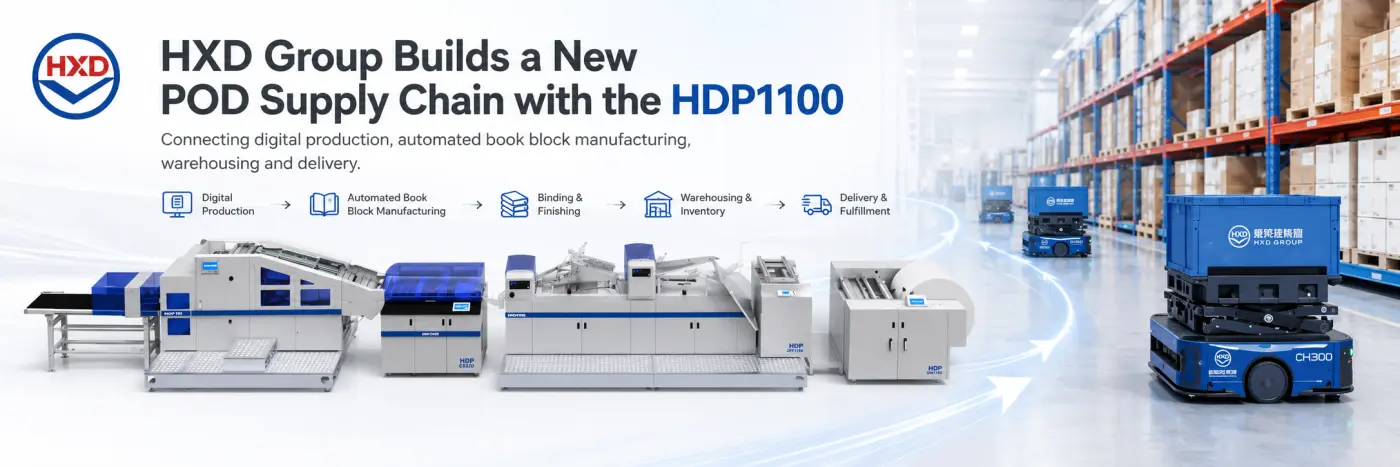
On May 20, 2026, Hongxianda (Gu'an) Digital Printing Co., Ltd. (“HXD”), a member of HXD Group, signed a strategic cooperation agreement with Dongguan Haoxin Precision Machinery Co., Ltd. (“HXCP”) for the introduction of the HDP1100 Wide-Format Roll to Book Block Digital Line.
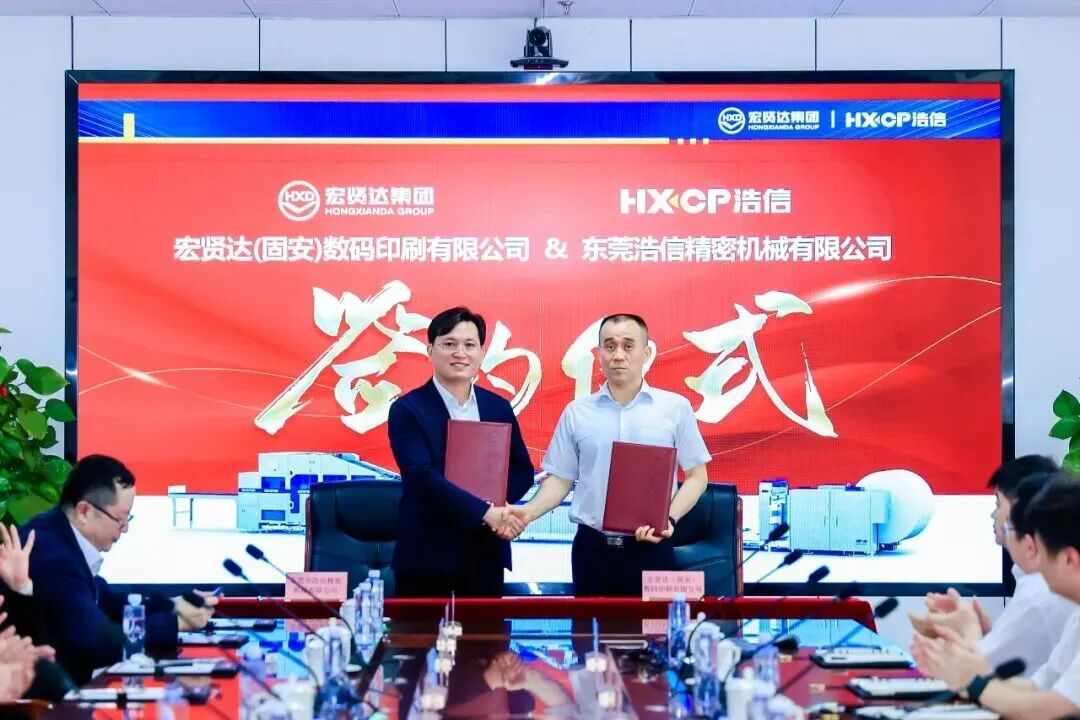
The project represents more than an expansion of printing and finishing capacity.
HXD Group has built its core business around book warehousing, transportation, order fulfilment and distribution. By adding digital book production to this established infrastructure, the group is moving upstream into print-on-demand publishing and developing a more integrated service model for publishers.
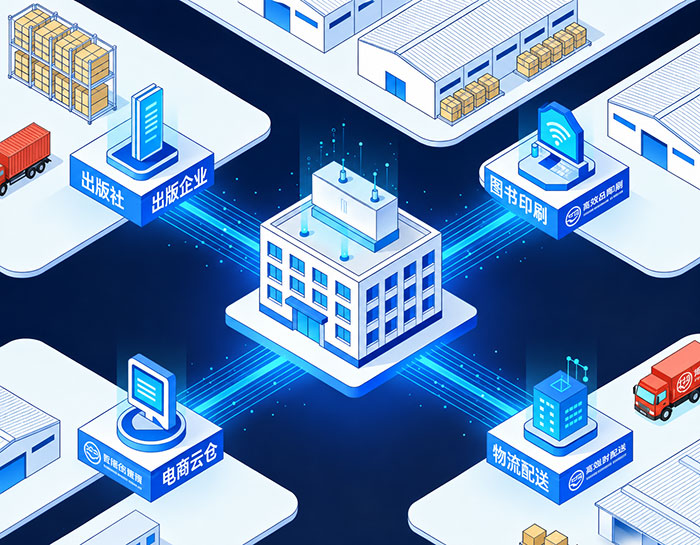
The objective is to connect digital printing, automated book block production, binding, warehousing and delivery within a coordinated workflow. This will allow books to be produced in smaller quantities, replenished according to actual demand and, where appropriate, dispatched without entering long-term storage.
For HXD Group, the HDP1100 is therefore not simply another production line. It is part of the infrastructure required to create a new publishing supply chain model.
China's Publishing Market: Scale Combined with Inventory Risk
China has one of the world's largest book publishing and distribution markets. Its scale creates substantial production opportunities, but it also exposes a long-standing structural problem: too many books are still printed according to forecasts rather than confirmed demand.
In the traditional publishing model, publishers and distributors often rely on relatively large print runs to reduce the unit cost of offset printing. This approach works well when demand is stable and predictable. It becomes less efficient when a title sells more slowly than expected, has a short commercial life or serves a specialised readership.
Unsold books occupy warehouse space, tie up working capital and generate repeated handling and management costs. Some eventually have to be discounted, pulped or otherwise written off.
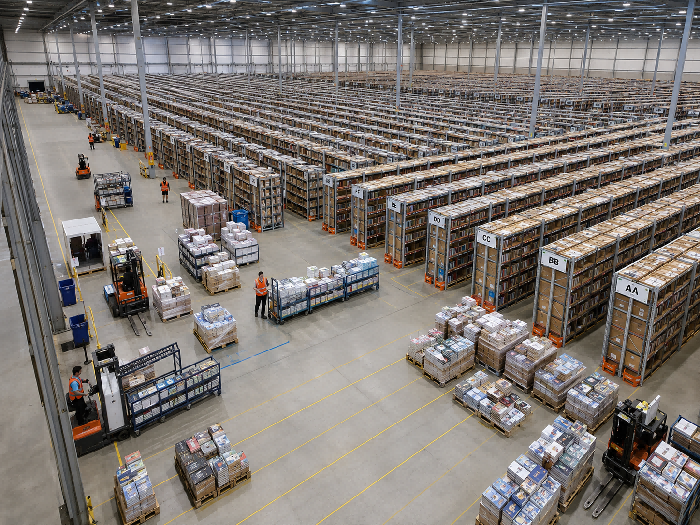
Inventory pressure is not a recent issue in China. It has been discussed within the publishing industry for many years. Official and industry reports have repeatedly identified inventory reduction and more demand-driven production as important reasons for developing POD.
The difficulty is not simply that some books fail to sell. The deeper problem is the growing unpredictability of demand.
A publisher may have thousands of titles with very different sales patterns:
New titles with uncertain market acceptance
Established titles requiring periodic replenishment
Academic and professional books with stable but limited demand
Educational books affected by seasonal ordering
Backlist titles that must remain available despite low annual volume
Promotional titles that may experience a sudden increase in demand
The conventional response has been to print enough copies to avoid a stock shortage. This reduces the risk of lost sales but increases the risk of excess inventory.
POD changes this calculation. Instead of asking how many copies might sell over an extended period, publishers can produce smaller quantities more frequently and respond to actual sales data.
Content E-Commerce Has Made Book Demand More Volatile
The rapid development of platform e-commerce, short-video marketing and livestream commerce has added another dimension to the Chinese book market.
In 2023, short-video e-commerce became China's second-largest book retail channel after conventional platform e-commerce. Its book sales value increased by 70.1% year on year. In 2024, content-driven e-commerce accounted for approximately 30.4% of China's book retail market by sales value.
This channel can generate demand much faster than traditional book retail.
A book may receive limited attention for months and then experience a sudden increase in orders after being recommended by an author, influencer or livestream host. At platform level, millions of books are now sold each day through content e-commerce. Individual livestream campaigns have also demonstrated the ability to move hundreds of thousands of copies within a short period.
These exceptional campaigns should not be treated as the normal sales pattern for every title. However, they illustrate an important operational reality: demand can become highly concentrated and difficult to forecast.
The opposite outcome is equally possible. A publisher may invest heavily in a title expected to become a bestseller, only to find that market demand is considerably weaker than anticipated. The remaining stock then becomes a financial and logistical burden.
Publishers therefore face two competing risks:
Printing too little may lead to lost sales when demand rises suddenly.
- Printing too much may result in years of storage, discounting and eventual disposal.
A responsive POD supply chain cannot eliminate market uncertainty, but it can reduce the amount of inventory that must be committed before that uncertainty is resolved.
Why a Book Logistics Group Is Moving into POD
HXD Group's move into digital book production is a logical extension of its existing position in the publishing supply chain.
The group has established capabilities in book storage, inventory management, order processing, transportation and nationwide distribution. It already works close to publishers and understands how books move from production into warehouses and ultimately to readers.
This provides three important foundations for a POD business.
Existing Publisher Relationships
HXD Group already serves publishing organisations that must manage large catalogues, changing demand and substantial inventories.
Adding POD allows the group to offer more services to the same customer base. Instead of handling books only after they have been printed, it can participate in production, replenishment and fulfilment planning.
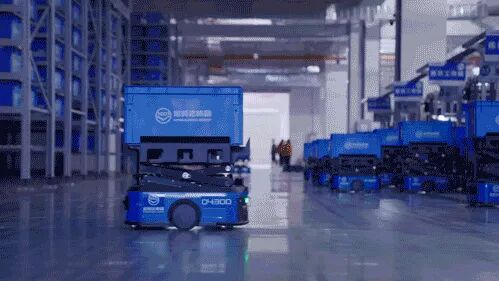
Warehousing and Distribution Infrastructure
A conventional printing company may need to transport finished books to an external distribution centre before orders can be fulfilled.
HXD can locate production close to its warehousing and logistics operations. Books can move directly from finishing to inventory or, in suitable cases, from finishing to shipment.
This can reduce intermediate transportation, handling and waiting time.
Access to Inventory and Order Data
A logistics operator can see which titles are moving, which are approaching stock-out and which are remaining in storage.
When production is connected with inventory and order information, replenishment decisions can be based on actual demand rather than periodic estimates alone.
The strategic advantage is not simply that HXD Group can print books. It is that the group can connect production with the information and infrastructure already used to store and distribute them.
The Development of China's Digital Printing Infrastructure
POD has been discussed in China for many years, but its commercial development has depended on the maturity of both digital printing and digital finishing.
High-speed inkjet production has developed rapidly in the Chinese book market. Domestic equipment suppliers have expanded, print quality and productivity have improved, and the costs of equipment, ink and related consumables have gradually become more accessible.
Industry data indicates that the installation of high-speed inkjet systems used for on-demand publishing increased significantly during 2023. China's publishing and printing authorities have also continued to promote digitalisation, intelligent production and the development of POD standards.
Offset printing remains highly efficient for long, stable production runs. It continues to have an important role in textbook, mass-market and other predictable high-volume applications.
However, offset production involves plate making, makeready, production preparation and a minimum economic run length. These characteristics make it less suitable for highly fragmented orders, frequent title changes and quantities measured in tens or hundreds of copies.
Digital inkjet printing removes the need for printing plates and makes it possible to change titles directly from digital files. Its economic advantage is strongest when quantities are relatively low, demand is uncertain or multiple jobs must be produced in rapid succession.
Yet printing was only one part of the problem.
For industrial POD to work, the finishing process also had to become variable, automated and economically viable at low quantities.
Digital Finishing as the Missing Link
A digital press can change from one title to another almost immediately. A conventional finishing line is generally designed to repeat the same format and page configuration over a longer production run.
This creates a mismatch.
If the press can print different books continuously but the finishing department must stop for manual adjustment, sorting or job separation, much of the flexibility provided by digital printing is lost.
The finishing system must be able to manage:
Frequent title changes
Different page counts
Changing book block thicknesses
Short and medium production runs
Correct signature sequence
Reliable separation between books
Integration with downstream binding
Industrial production speeds
This is the operational gap that the HDP1100 is intended to address.
The development of digital finishing systems from manufacturers such as HDP has helped move POD from isolated short-run printing toward a more complete industrial production workflow.
Producing one printed copy has been technically possible for some time. Producing one correctly organised, bindable book block within an efficient automated line is a more demanding requirement.
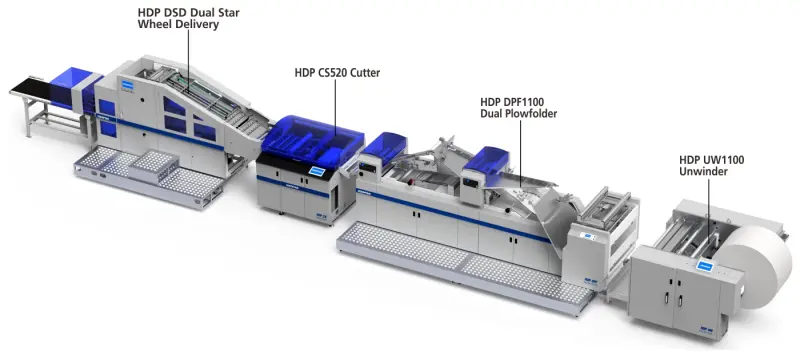
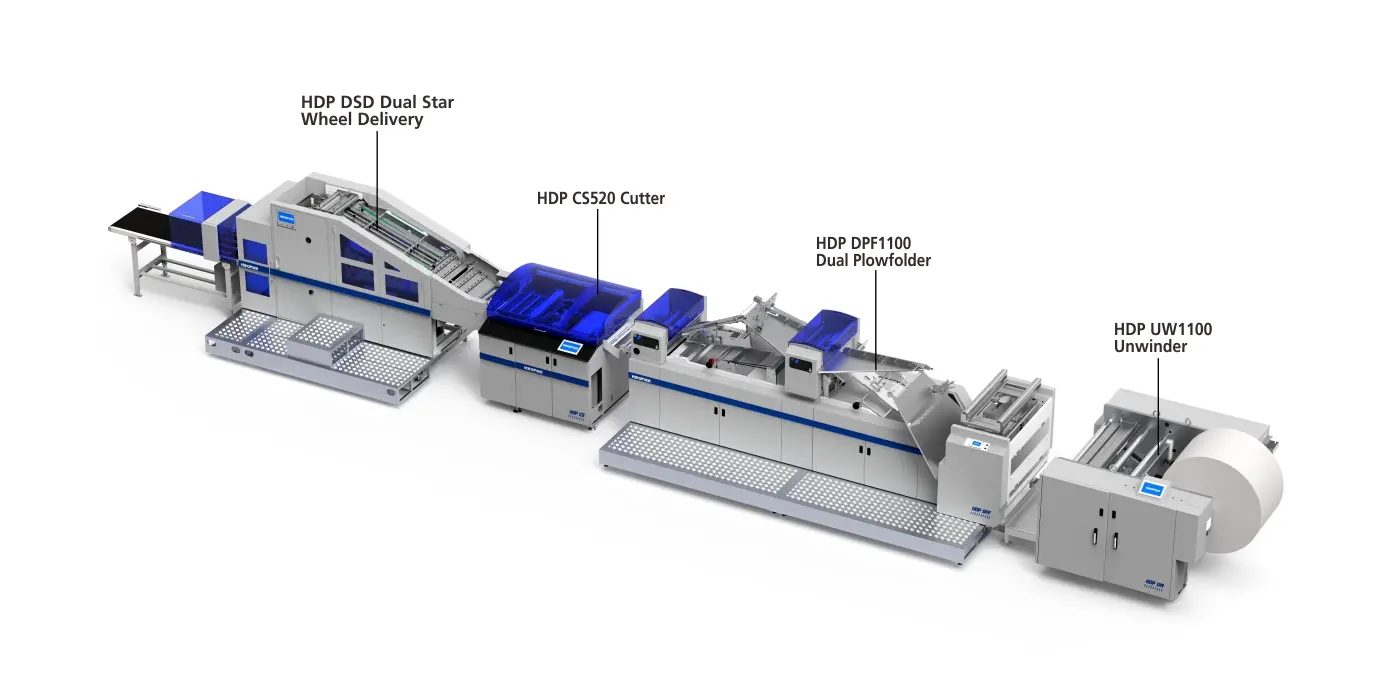
The HDP1100 Wide-Format Roll to Book Block Digital Line
HXD selected the HDP1100 Wide-Format Roll to Book Block Digital Line as the core book block production system for its POD operation.
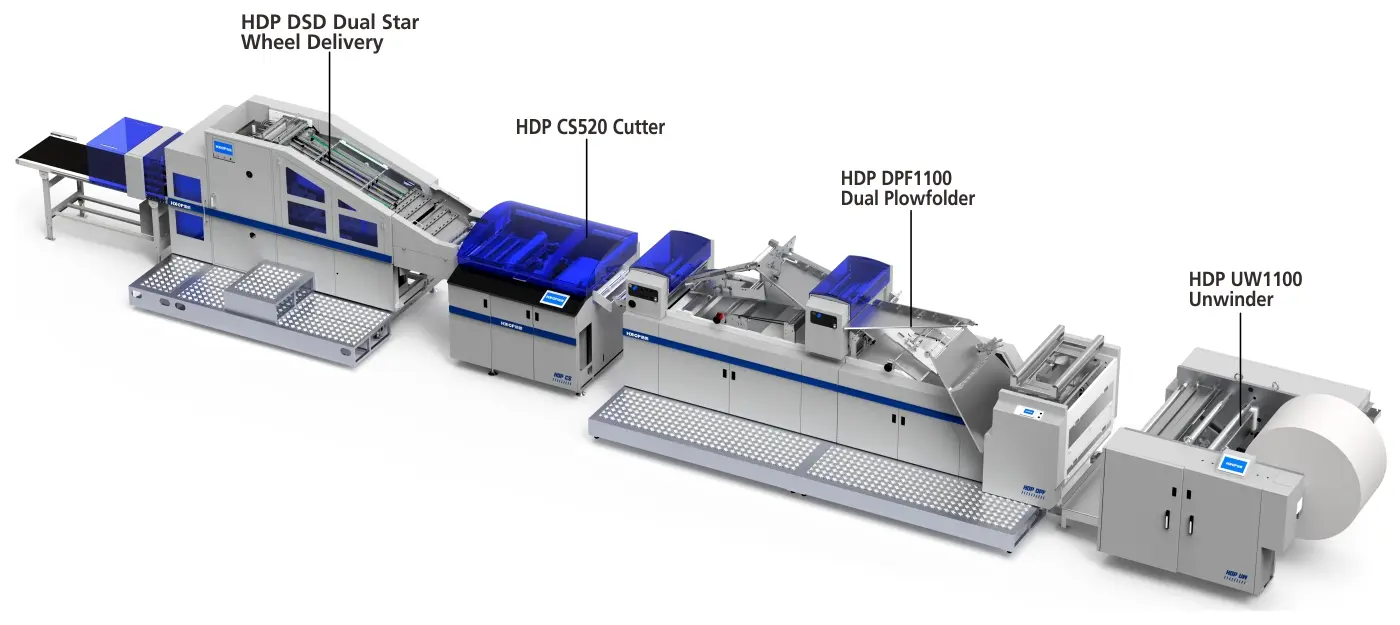 HDP1100 Wide-Format Roll-to-Book-Block Digital Line
The HDP1100 is designed for wide-format web-fed digital printing environments. It supports a maximum web width of up to 1,100 mm and production speeds of up to 200 metres per minute.
The system integrates several book block preparation processes into one continuous line:
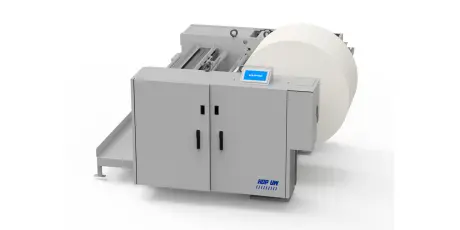
Web unwinding
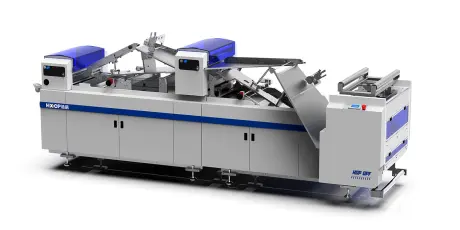
Longitudinal plow folding
Four-, six- or eight-page signature production
Precision cross-cutting
Side gluing
Signature separation
Ordered stacking and delivery
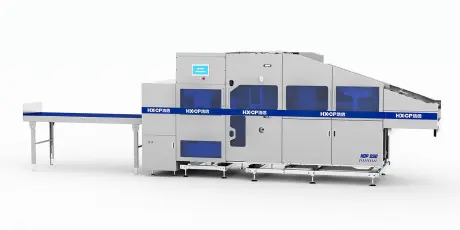
At the delivery end, the HDP DSD Dual Star Wheel Delivery controls signature separation and stacking. The star-wheel delivery structure is designed to maintain stable output and correct sequence as individual book blocks pass through the line.
The system can also be configured with application-specific functions such as dynamic perforation and edge trimming.
Its wide-format design allows HXD to match the output of large digital web presses while processing several pages across the web. This improves production efficiency and makes the line suitable for industrial book manufacturing rather than only small-format digital work.
From Variable Printing to Variable Books
The central value of the HDP1100 lies in its ability to support changes between successive book blocks.
In a conventional long-run workflow, hundreds or thousands of identical books are produced before the next job begins. In a POD workflow, the sequence may contain several titles, different quantities and changing page counts.
The HDP1100 is designed to accommodate changing book block thicknesses within the production flow without requiring a conventional makeready cycle between every order.
This provides the production basis for:
One-title short runs
Mixed-title production
Automatic stock replenishment
Backlist production
Educational and professional publishing
Journals and periodicals
Workbooks and exercise books
Region-specific or customer-specific editions
Book-of-one production where supported by the complete workflow
The line does not create a POD business by itself. Files, job data, print management, binding, quality control, inventory systems and order fulfilment must also be integrated.
However, it removes an important physical limitation by allowing wide-format digitally printed webs to be converted into organised book blocks within an automated process.
A Shorter Publishing Supply Chain
In a conventional supply chain, books may pass through several independent organisations and locations:
Publisher forecast → printing → binding → transportation → warehouse receiving → storage → order processing → delivery
Every transfer adds time, handling and coordination. It also increases the quantity of work in progress and finished stock moving through the system.
HXD Group is developing a shorter model:
Demand signal → digital printing → automated book block production → binding → inventory or direct dispatch
The difference is not that warehousing disappears completely. The difference is that production and inventory decisions can be coordinated more closely.
This supports two complementary operating models.
Print to Stock
A title is replenished in a small batch when inventory reaches a defined threshold.
This is suitable for books with recurring but uncertain demand. Publishers can maintain availability without committing to another large print run.
Print to Order
A book is produced after an order, consolidated order or confirmed demand signal has been received.
Depending on delivery requirements and production economics, the completed book may move directly into the distribution network without entering long-term storage.
HXD Group can use both models according to the sales characteristics of each title.
Creating a New Service for Publishers
The project enables HXD Group to develop a service that extends beyond printing or logistics as separate activities.
The group can potentially support publishers across a broader process:
Receive title files and production specifications.
Monitor orders and inventory levels.
Determine an appropriate production quantity.
Print the required quantity digitally.
Convert the printed web into completed book blocks.
Complete the required binding process.
Transfer the books to stock or directly to fulfilment.
Dispatch orders through the existing logistics network.
This model can provide particular value for:
Backlist titles with low but continuing demand
Academic and professional publications
New titles with uncertain initial sales
Books promoted through short-video or livestream channels
Regional editions
Publisher inventory replenishment programmes
Titles that must remain available but do not justify conventional reprinting
Rather than selling warehousing, printing and delivery as unrelated services, HXD Group can offer them as parts of one coordinated supply chain.
POD Does Not Mean Eliminating Every Book in Storage
"Zero inventory" is often used to describe the objective of POD. In practice, eliminating all inventory is neither necessary nor economically appropriate for every title.
High-volume books with predictable demand may still be produced more efficiently in longer conventional runs. Fast-moving titles may require safety stock to guarantee immediate delivery. Seasonal educational books may also need to be produced in advance.
A realistic POD strategy classifies titles according to their demand characteristics.
For example:
High-volume, predictable titles remain in conventional production.
Medium-volume titles are replenished in smaller, more frequent batches.
Low-volume titles are produced against accumulated or individual orders.
New titles begin with conservative quantities until demand becomes clearer.
Backlist titles remain digitally available without permanent physical stock.
The commercial objective is therefore better described as inventory optimisation, not the absolute elimination of inventory.
By combining production, warehousing and distribution, HXD Group is positioned to make these decisions across the complete supply chain rather than within one isolated production department.
Business Value Created by the HDP1100
The HDP1100 supports the HXD project in four connected areas.
Production Flexibility
The line allows different titles, page counts and book block thicknesses to be processed within a digitally controlled production environment.
Industrial Capacity
Its 1,100 mm web width and production speed of up to 200 m/min allow POD to move beyond low-volume workshop production and into a higher-capacity manufacturing environment.
Reduced Process Fragmentation
Unwinding, folding, cutting, gluing, separation and stacking are combined within one line, reducing intermediate handling between individual processes.
Supply Chain Integration
The finished book blocks can enter downstream binding and then move into HXD Group's warehousing and distribution network.
The value of the equipment therefore depends not only on its output speed, but also on how it connects printing with the rest of HXD Group's operation.
A New Role for a Logistics Enterprise
HXD Group's investment reflects a broader transformation in publishing supply chains.
Traditionally, printing companies manufactured books, logistics companies stored and transported them, and publishers coordinated the process through forecasts and purchase orders.
Digital production makes these boundaries less fixed.
A logistics enterprise with strong publisher relationships, physical infrastructure and fulfilment capabilities can move upstream into manufacturing. A printing company can move downstream into inventory management and direct distribution. Publishers can increasingly manage the entire process through production and sales data.
HXD Group is using its existing strengths to participate in this change.
Its competitive advantage will not come from owning a digital production line alone. It will come from combining that line with warehouse capacity, order information, publisher relationships and an established delivery network.
Project Significance
The cooperation between HXD and HDP demonstrates how digital finishing equipment can enable a business model rather than simply increase production capacity.
The HDP1100 provides the physical connection between wide-format digital printing and bindable book blocks. HXD Group provides the customer network, logistics infrastructure and fulfilment capabilities needed to translate that production flexibility into a supply chain service.
Together, these capabilities support a model in which books can be:
Produced in quantities closer to actual demand
Replenished more frequently
Kept available without large permanent inventories
Manufactured closer to the point of distribution
Dispatched more quickly after production
Managed through a combination of digital production and logistics data
Because the project is at the implementation stage, its final productivity, cost savings and inventory reduction should be evaluated after stable commercial operation. The strategic value, however, is already clear: the HDP1100 gives HXD Group the production infrastructure required to move from conventional book logistics toward demand-driven publishing fulfilment.
Looking Ahead
China's POD market is being driven by several developments occurring at the same time:
Persistent pressure to reduce book inventory
More fragmented and less predictable demand
The growth of short-video and livestream book sales
Wider adoption of high-speed digital inkjet printing
Lower barriers to domestic digital printing technology
Continued development of automated digital finishing
Increasing integration of publishing, production and fulfilment data
Digital printing makes short-run and variable production technically possible. Digital finishing makes it possible to convert that output into organised book blocks efficiently. Logistics integration determines whether those books can reach the market quickly and economically.
HXD Group brings these three elements together.
With the HDP1100 Wide-Format Roll to Book Block Digital Line at the centre of its new production workflow, HXD is building a POD model designed not merely to print fewer copies, but to change when, where and why books are produced.
For publishers, the potential result is a more responsive supply chain with lower inventory exposure and greater title availability.
For HXD Group, it represents a transition from handling books after production to participating directly in demand-driven book manufacturing.
For HDP Digital, the project demonstrates that advanced finishing technology can do more than automate an existing process. It can provide the operational foundation for an entirely new customer business model.
About the HDP1100
The HDP1100 Wide-Format Roll to Book Block Digital Line is an automated finishing system designed for wide-format, web-fed digital book production.
With a maximum web width of up to 1,100 mm and operating speeds of up to 200 m/min, the line integrates unwinding, plow folding, precision cutting, side gluing, signature separation and ordered stacking.
It supports four-, six- and eight-page signature configurations and can be equipped with functions such as dynamic perforation and edge trimming.
Designed for variable book production and industrial POD workflows, the HDP1100 provides a scalable connection between digital web printing, downstream binding and demand-driven book fulfilment.