Plow Folding vs. Former-Board Folding in Digital Finishing
Longitudinal folding is a critical first step in roll-fed book production. It folds the printed paper web parallel to its running direction, reducing the web width and preparing it for cutting, cross-folding, stacking and binding.
Two technologies are commonly used for this process: plow folding and former-board folding.
Both can create a longitudinal fold, but they are designed around different production requirements. Former-board folding is traditionally associated with high-speed, standardized web production. Plow folding provides the flexibility, compact configuration and process control required by modern digital finishing and print-on-demand book manufacturing.
What Is Former-Board Folding?
Former-board folding uses a large triangular guide plate to redirect the moving paper web. As the web travels over the former, both sides are gradually brought together to create a longitudinal fold. Folding rollers then compress and stabilize the folded web.
The process is mechanically simple and largely passive, allowing it to operate efficiently at high web speeds. For this reason, former-board folding has traditionally been used for long production runs with stable web widths, fixed fold positions and standardized finished formats.
Its main strengths include:
High continuous production speed
Simple and reliable mechanical construction
Low maintenance requirements
Stable performance for fixed-format jobs
However, its strengths are based on repetition. When the product format, fold position or paper configuration changes frequently, adjustment becomes more complex. A conventional former board is therefore less suitable for digital production environments characterized by short runs, changing book formats and frequent job changeovers.
What Is Plow Folding?
Plow folding uses adjustable folding plates, shoes, rails and guide rollers to gradually turn part of the moving paper web over another section.
Instead of guiding the entire web around one large triangular surface, the plow-folding system controls the paper progressively along a defined folding path. The folding position and paper direction can therefore be adapted more easily to different formats and production requirements.
Depending on the machine configuration, plow folding can support:
Centered or offset longitudinal folds
Symmetrical or asymmetrical folding
Different folding directions
Multiple consecutive longitudinal folds
Creasing or perforating before folding
Connection with dynamic cutting and cross-folding modules
This modular structure makes plow folding particularly suitable for automated digital finishing lines.
Why Plow Folding Is Better for Print-on-Demand Books
Faster Changeovers for Short-Run Production
Print-on-demand production may involve many book titles, formats and page counts within the same shift. The profitability of this model depends not only on maximum running speed, but also on how quickly the line can move from one job to the next.
Plow-folding units are easier to integrate with motorized positioning, stored job settings and automated production controls. This reduces manual adjustment and supports faster transitions between book formats.
Former-board folding remains efficient when producing the same specification continuously. Plow folding is more effective when every production batch may be different.
Better Integration with Digital Workflows
Modern digital book production begins with variable print data. The finishing line must then interpret this data and convert the printed roll into correctly ordered book signatures.
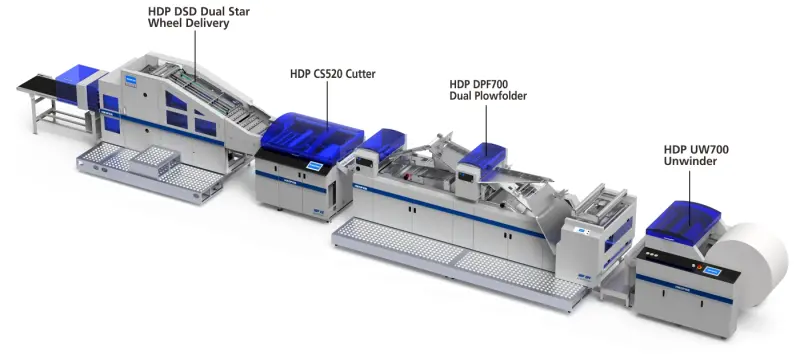
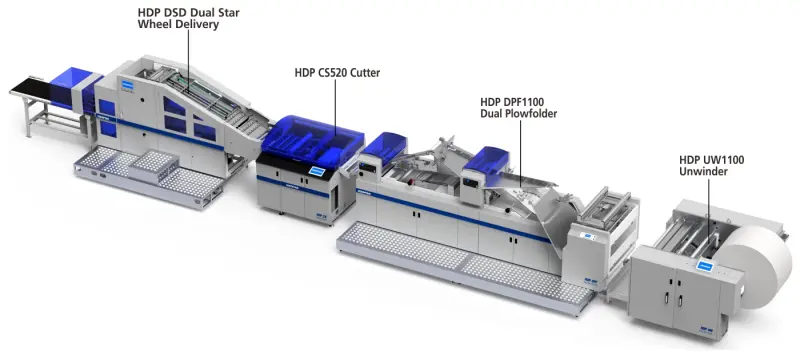
Plow folding can be positioned directly between the unwinder and dynamic cutter in a compact, straight-through workflow:
Unwinding → Creasing and Perforating → Plow Folding → Dynamic Cutting → Dynamic Folding → Stacking and Bundling
This modular structure allows each processing stage to be independently controlled and synchronized.
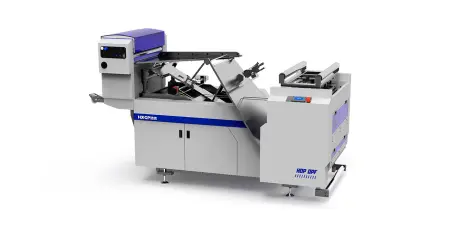
In the HDP Roll to Book Block Digital Line, the HDP Plowfolder creates the initial longitudinal fold before the web enters barcode-controlled cutting and dynamic signature folding.
Greater Flexibility for Variable Page Counts
Traditional book production normally uses fixed signature structures, such as identical 16-page or 32-page signatures throughout the entire book.
Print-on-demand books are different. Each title may have a different total page count, and the final signature may contain fewer printed pages than the standard signature structure allows. This can create unnecessary blank pages or require separate handling of the final section.
The plow-folding stage in the HDP Roll to Book Block Digital Line prepares the web for the HDP Dynamic Cutter and HDP Dynamic Folder. Barcode data determines the required cutting length and folding path for each signature.
The system can dynamically combine different signature structures, such as:
8-page and 12-page signatures
16-page and 24-page signatures
Standard signatures and automatically processed tail signatures
This allows the production line to reduce unnecessary blank pages to no more than three per book while maintaining continuous operation.
More Controlled Paper Handling
Digital printing may involve lightweight book paper, coated stocks or paper surfaces with high ink coverage. These materials require stable web tension and controlled folding geometry.
In plow folding, the paper is gradually guided through the folding path rather than being redirected around one large former surface. Creasing or pre-perforation can also be applied before the fold to define the folding line and reduce paper resistance.
This controlled process helps improve:
Fold consistency
Web stability
Signature alignment
Handling of different paper characteristics
Protection of digitally printed surfaces
The actual result still depends on paper weight, grain direction, moisture, ink coverage and running speed, but plow folding provides greater process adjustability.
Compact and Modular Line Configuration
Print-on-demand production requires scalable equipment. Printers may initially need only a roll-to-signature system and later connect it with additional sewing, saddle-stitching, perfect-binding or hardcover equipment.
A plow folder can be installed as an independent module within a digital finishing line. It does not require the large and relatively fixed folder architecture commonly associated with traditional web presses.
This allows the production line to be configured according to actual applications, available factory space and downstream binding requirements.
When Is Former-Board Folding Still Appropriate?
Former-board folding remains suitable when production is based on:
Extremely long print runs
One stable web width
One fixed fold position
Standardized product formats
Maximum continuous web speed
It is a proven solution for repetitive production.
Plow folding is more appropriate when production requires:
Short and medium print runs
Frequent job changes
Multiple book formats
Variable book lengths and page counts
Barcode-controlled automation
Compact roll-to-signature workflows
Flexible connection with downstream binding equipment
Former-board folding is optimized for high-speed repetition. Plow folding is optimized for production flexibility.
For print-on-demand books and digital finishing, flexibility is increasingly more important than running speed alone. Printers must process different titles, formats and page counts with minimal setup time while maintaining correct signature order and reliable downstream compatibility.
By combining plow folding with barcode-controlled cutting, dynamic folding and automatic signature delivery, the HDP Roll to Book Block Digital Line converts variable digital print content into properly folded, sequentially ordered book signatures.
It therefore provides a practical bridge between roll-fed digital printing and both digital and conventional bookbinding, making plow folding a more suitable foundation for automated print-on-demand book production.