The rapid growth of digital printing is changing the way examination papers, assessment materials and educational documents are produced. Schools, examination authorities and educational publishers increasingly require shorter production cycles, smaller order quantities and greater flexibility across different subjects, grades, regions and test versions.
Digital presses can already print these jobs efficiently. The more difficult challenge often appears after printing.
Conventional finishing workflows usually depend on multiple standalone operations, manual paper handling and repeated setup. Printed rolls must be cut, folded, separated, collated, stacked and prepared for delivery or binding. When these operations are not properly integrated, the finishing process can become the bottleneck of the entire production line.
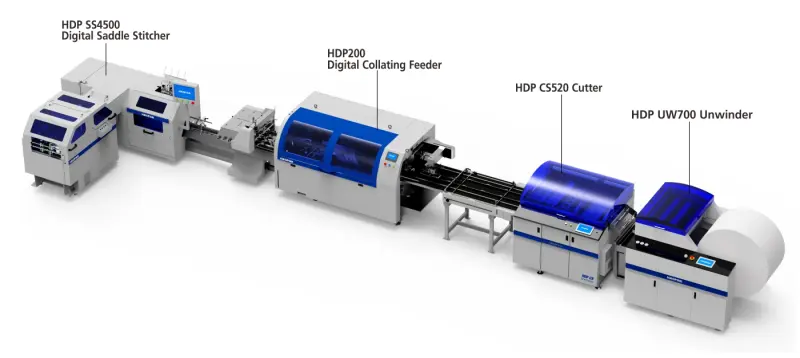
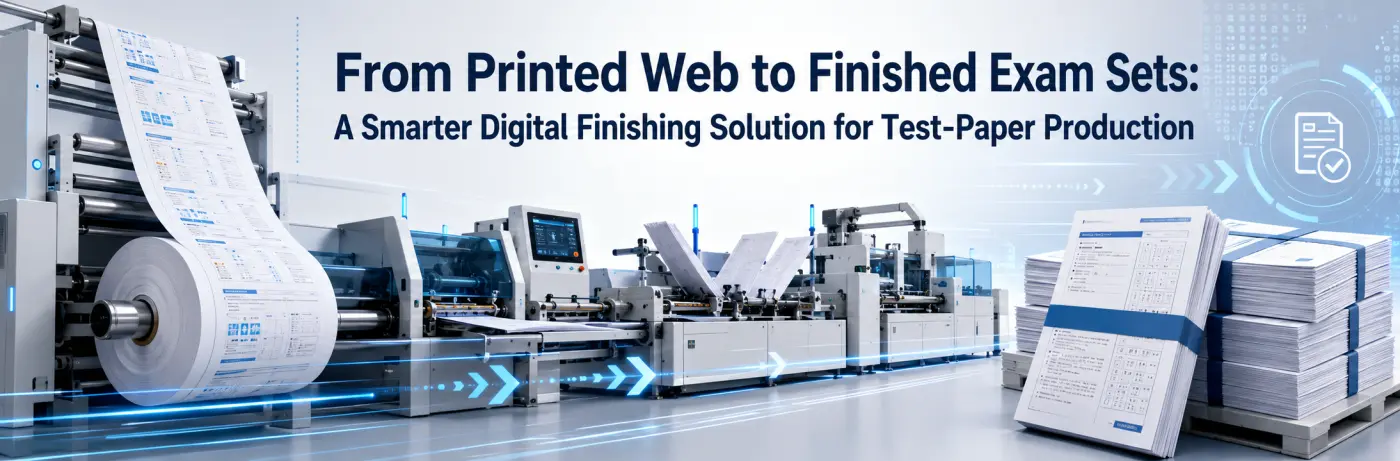
The HDP Digital Exam Paper Finishing Solution addresses this challenge by connecting roll unwinding, longitudinal folding, cross-cutting, job separation, spot gluing, stacking, pressing and collection into a coordinated production workflow.
Why Exam-Paper Finishing Requires a Dedicated Solution
Examination papers are different from standard commercial print products.
A typical order may contain hundreds or thousands of individual test sets, while each set must maintain the correct page sequence. Different versions may also need to be produced for different schools, regions, subjects or examination rooms. At the same time, the production window is often extremely short, and delivery accuracy is critical.
This creates several finishing requirements:
Every exam set must contain the correct pages in the correct order.
Different jobs must be separated automatically and clearly.
Thin paper must remain stable during high-speed transport and stacking.
Blank pages caused by imposition should be minimized.
The system must support both small-batch and high-volume production.
Finished sets must be easy to collect, pack, distribute or transfer to downstream binding.
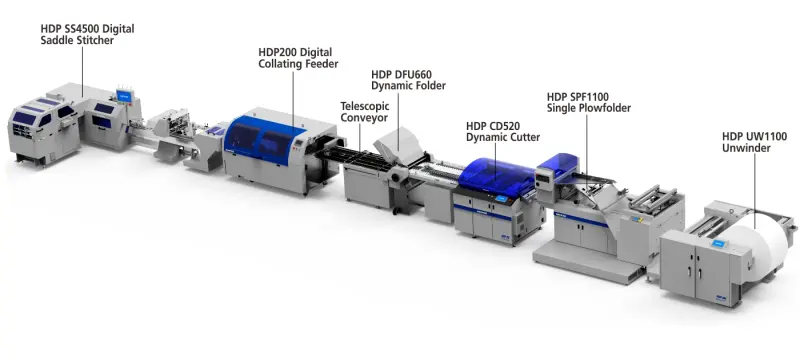
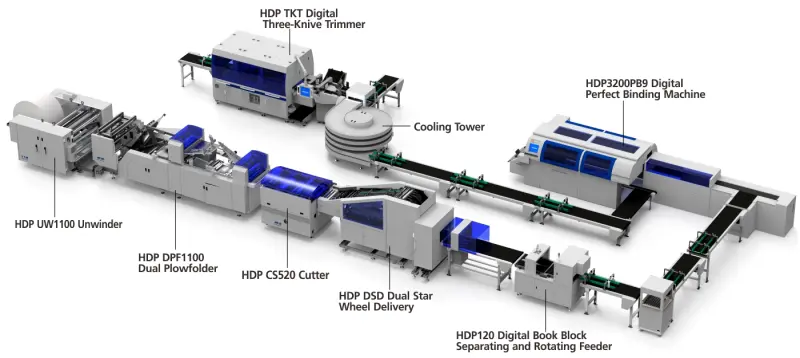
The solution shown in the HDP workflow is built around a modular production concept. Depending on the printed web width, job volume and finished-product structure, the line can combine unwinding, plow folding, slitting, variable cutting, spot-glue stacking, gathering and downstream binding processes. The broader system architecture also allows the same digital finishing platform to produce exam sets, saddle-stitched products, perfect-bound books and sewn book blocks.
The Core Workflow
A typical digital exam-paper finishing process can be configured as follows:
Digital Printing → Unwinding → Plow Folding or Slitting → Cross-Cutting → Spot Gluing and Stacking → Pressing → Set Collection
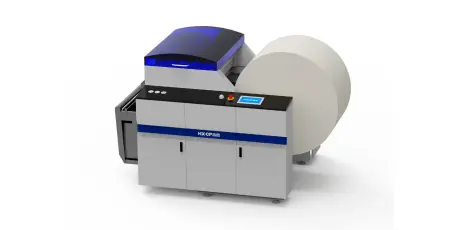
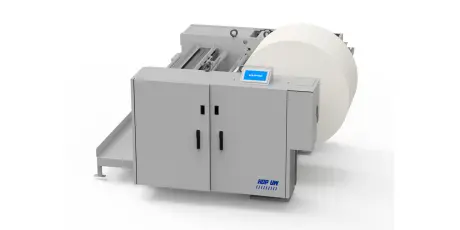
The printed roll first enters an unwinder, which maintains stable web tension and feeds the material continuously into the finishing line.
Depending on the selected imposition, the web can then pass through a plow folder. This creates the required longitudinal fold before the paper is cross-cut into individual sheets or multi-page sections.
Printed cutting marks and set-separation marks control the cutting and stacking sequence. The sheets belonging to the same exam paper are stacked together, while a controlled glue application helps stabilize the set. The finished stack is then pressed and delivered for collection, packing or further processing.
This eliminates repeated manual transfer between separate machines and creates a more predictable production flow.
Solution 1: Standard-Width Production for Short Runs
For smaller examination-paper orders, the standard-width solution offers a compact and straightforward workflow:
Unwinding → Cutting → Stacking → Pressing → Collection
The source configuration is designed around a 700 mm web width and a production speed of up to 150 metres per minute. It is particularly suitable for short-run digital exam-paper orders produced on a standard-width digital press. One of its main advantages is that the workflow can be imposed without generating blank pages.
A representative configuration includes:
HDP UW700 standard unwinder
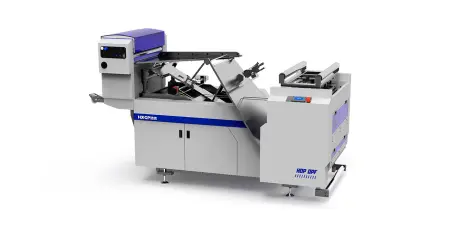
HDP CS520 Cutter
HDP DSD Dual Star Wheel Delivery
The solution is relatively compact and requires fewer processing stages. Because there is no longitudinal folding stage, production control is also simpler.
Its main limitation is productivity. Compared with a wide-web configuration, fewer pages can be imposed across the web, so more running length is required to complete the same order.
This solution is therefore best suited to:
Short-run examination papers
School-specific test materials
Regional assessment papers
Frequently changing subjects or versions
Jobs where blank-page elimination is more important than maximum output
For digital printers entering the education market, this configuration provides a practical starting point without requiring an excessively long or complex production line.
Solution 2: Wide-Web Production for Higher Volumes
For larger exam-paper orders, a wide-web configuration offers significantly higher efficiency.
The recommended workflow is:
Wide-Web Unwinding → Plow Folding → Cross-Cutting → Spot-Glue Stacking → Pressing → Collection
The referenced solution uses a web width of approximately 900 mm and also operates at up to 150 metres per minute. Because the wider web accommodates a more efficient page imposition, it can process substantially more pages within the same running length.
A typical configuration includes:
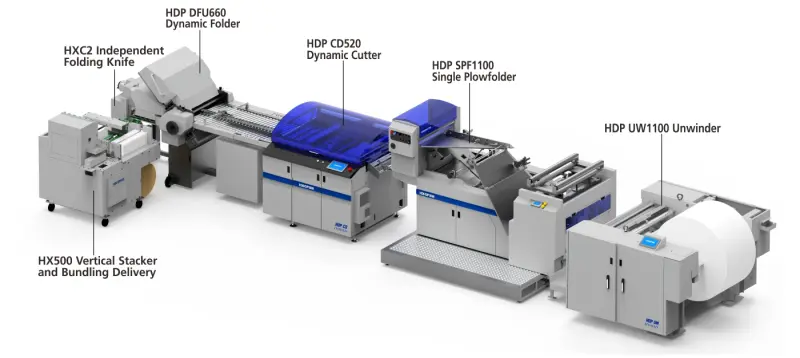
HDP UW1100 Wide-format Unwinder
HDP SPF1100 Single Plow Folder
HDP CS520 Cutting Unit
HDP DSD Dual Star Wheel Delivery
The wide web is first folded longitudinally, reducing the effective width and creating a multi-page section. The folded web is then cut into individual exam sets, stacked, pressed and collected.
The principal advantage is higher productivity. For large educational projects, the wider imposition can reduce paper travel, improve press utilization and increase finishing output.
However, the imposition must be planned carefully. When the total page count is a multiple of four, the job can be produced without blank pages. For other page counts, the workflow may generate one blank page that must be removed or accepted according to the customer’s production requirements.
This configuration is particularly suitable for:
Provincial or regional examinations
High-volume school assessment programs
Standardized test production
Large educational publishing projects
Centralized print facilities serving multiple institutions
Flexible 8-Page and 4P × 2 Production Strategies
Wide-web exam production can be further optimized through different folding and imposition methods.
8-Page Configuration
In the 8-page method, the web is folded and processed into eight-page sections. This approach offers good production stability because each finished section has sufficient body and stiffness during transport and stacking.
It is generally the preferred solution when the exam-paper format, page count and printing layout are compatible with an 8-page structure.
4P × 2 Configuration
Another approach is to place two four-page sections symmetrically across the web. After folding and centre slitting, the left and right sections can be processed into separate spot-glued stacks.
This method provides greater flexibility for jobs that do not fit a conventional 8-page imposition. It can also improve web utilization for certain finished formats.
However, four-page sections made from lightweight paper can be less stable during high-speed transport. Thin sheets may flutter or shift during stacking, which can require a reduction in production speed. The source workflow specifically identifies this as a limitation of the 4P stacking method.
The final choice between 8P and 4P × 2 should therefore consider:
Paper weight and stiffness
Finished exam-paper format
Total number of pages
Digital press web width
Required production speed
Acceptable number of blank pages
The Role of Spot Gluing
Spot gluing is an important part of this finishing concept.
Loose examination sheets can easily become misaligned during pressing, transportation, packing or distribution. A controlled glue application temporarily or permanently stabilizes the sheets belonging to the same set.
Compared with conventional binding, spot gluing uses only a small amount of adhesive and does not require a full book spine. It is therefore suitable for examination materials that must remain organized during delivery but may later need to be separated, distributed or handled individually.
The gluing position and adhesive strength can be selected according to the finished product. For example, glue can be applied along one side, at selected points or between specific sections.
This creates a clean, manageable exam-paper set without adding unnecessary binding cost.
Production Control and Set Integrity
Exam-paper production requires more than mechanical speed. It requires reliable set control.
The workflow uses printed cutting marks and set-separation marks to identify where each exam paper begins and ends. These marks allow the cutter and stacker to coordinate the number of sheets in each set and to create a clear separation between consecutive jobs. Both the standard-width and wide-web configurations use this mark-based control method.
This is particularly important when the digital press produces several examination versions in one continuous roll.
With the appropriate print workflow, different subjects, schools or test versions can be arranged sequentially on the roll. The finishing line then converts the printed web into clearly separated physical sets without requiring operators to manually count and divide every job.
Selecting the Right Configuration
There is no single production line that is ideal for every examination-paper application.
The correct solution depends on the relationship between order volume, web width, paper characteristics, page count and required delivery time.
The standard-width configuration is more suitable when:
Order quantities are relatively small.
Jobs change frequently.
Production space is limited.
Avoiding blank pages is a priority.
Maximum output is not the primary concern.
The wide-web configuration is more suitable when:
Order quantities are high.
The digital press supports wide-web printing.
Faster production is required.
Page layouts can be optimized in multiples of four.
The printer wants to reduce production cost per exam set.
For operations handling a wide range of educational jobs, the most effective strategy may be a modular line that can process different folding, cutting and stacking patterns according to each order.
From Isolated Machines to an Integrated Digital Workflow
The real value of a digital exam-paper finishing solution does not come from one individual machine. It comes from coordinating the complete process.
When unwinding, folding, cutting, gluing, stacking and delivery are integrated, the printer can reduce intermediate handling, shorten makeready time and improve production consistency.
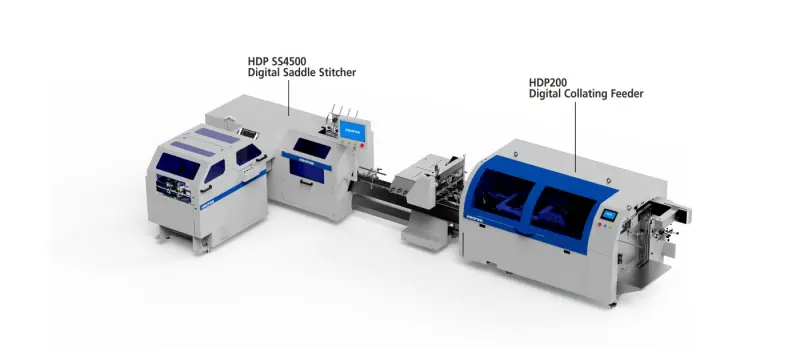
The modular architecture also creates room for future expansion. A printer may initially install a roll-to-stack solution for examination papers and later add gathering, saddle stitching, perfect binding, sewing or three-knife trimming equipment for other educational and publishing products.
The same production platform can therefore support:
Loose examination sets
Spot-glued test papers
Saddle-stitched workbooks
Perfect-bound study materials
Sewn educational books
Short-run textbooks and exercise books
Smarter Finishing for Time-Critical Education Printing
Digital printing has already made examination-paper production more flexible. Digital finishing must now deliver the same level of responsiveness.
By converting printed rolls directly into folded, cut, separated and spot-glued exam sets, the HDP Digital Exam Paper Finishing Solution helps printers reduce manual handling, improve production control and respond more effectively to short delivery schedules.
Whether the requirement is a small batch of school-specific test papers or a large regional examination program, the workflow can be configured around the appropriate web width, imposition structure and production volume.
The result is not simply a faster finishing line. It is a more controlled and scalable production system—from printed web to ready-to-distribute exam sets.